
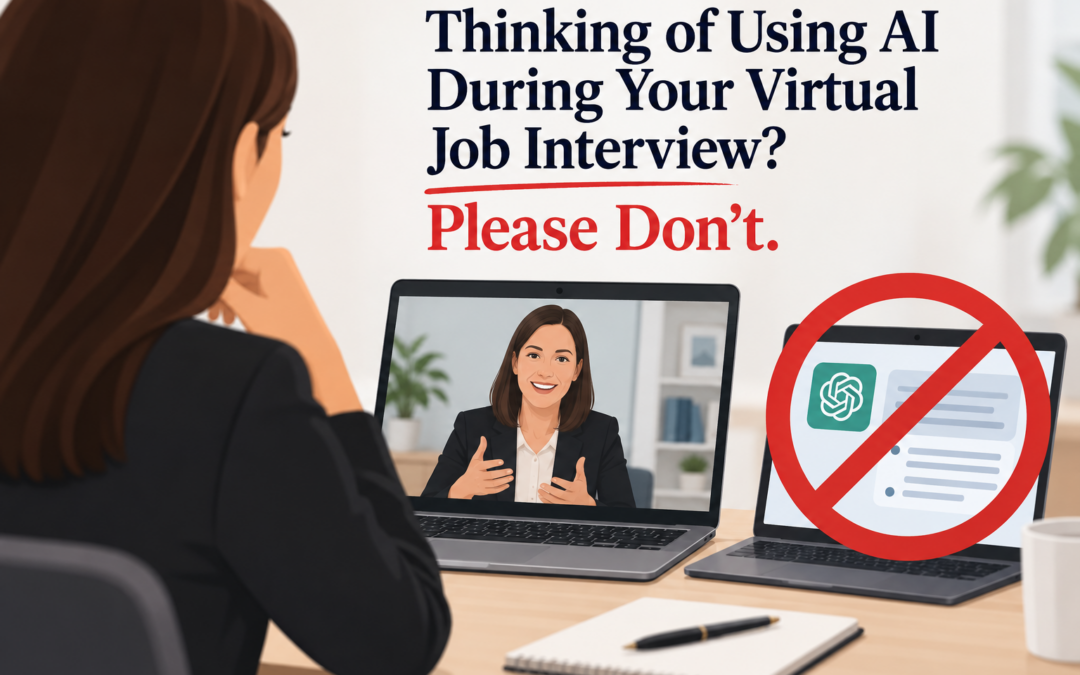
Until recently, it had never occurred to me that a candidate might have AI open on a second screen, or use a phone or tablet, to feed in an interviewer’s questions and generate the “perfect” response in real time.
Apparently, it happens.
My advice? Don’t do it.
There are many reasons why using AI this way during an interview can hurt rather than help you.
First, there is no “perfect” answer.
You may think AI is helping you formulate the best possible response, but it may actually be suppressing your personality and taking away one of the most important elements of the interview process: the human connection.
An interview is meant to be a conversation. The employer wants to hear how you think, how you communicate, and how you respond when you do not have a perfectly scripted answer.
Second, reading an AI-generated response naturally is much harder than it sounds.
Reading anything on the fly while making it appear that you are speaking spontaneously is incredibly difficult. You may believe you can do it convincingly, but an experienced interviewer may notice changes in your cadence, unnatural pauses, unusually polished phrasing, or a disconnect between the question asked and the way you respond.
Instead of creating a great impression, you may inadvertently create a poor one.
Third, using another device or screen can be distracting.
If your eyes repeatedly dart away from the screen, you pause while waiting for a response, or you appear to be typing while the interviewer is speaking, the interviewer may simply conclude that you are distracted or disengaged.
They may never realize that you are using AI. They may only know that you do not seem fully present in the conversation.
Fourth, it interferes with your ability to evaluate the employer.
An interview is a two-way process. The employer is assessing you, but you should also be assessing the employer.
Some of the people interviewing you may become your supervisors or colleagues. You should be paying attention to how they communicate, how they describe the position and workplace, how they interact with one another, and how comfortable you feel speaking with them.
It is much harder to assess whether you might work well together when part of your attention is focused on interacting with AI.
Fifth, AI can put words in your mouth that you may later have to defend.
An AI-generated response could overstate your experience, suggest knowledge you do not actually possess, or characterize your background in a way that is not entirely accurate.
If you repeat that response without catching the problem, the interviewer may reasonably believe you possess a skill or level of experience that you do not have. Correcting yourself afterward can create another problem: the interviewer may wonder why you made the statement in the first place.
Either scenario can undermine your credibility.
Sixth, the difference may become obvious later in the interview process.
A virtual interview is often only one stage of the process. If you are later invited to an in-person interview and your communication style, level of detail, or responses are markedly different, the discrepancy may raise questions.
You do not want an employer wondering which version represents the person they would actually be hiring.
There are plenty of other reasons not to rely on AI to answer interview questions in real time, including confidentiality concerns if you are entering information about an employer, client, matter, or other sensitive subject into an AI tool.
The job market has been difficult, and it is understandable that candidates want every possible competitive advantage. Real-time AI assistance during an interview, however, is very likely to create more risk than advantage.
Give yourself the opportunity to succeed based on your own experience, judgment, personality, and ability to connect with the people on the other side of the screen.
Ultimately, employers want to understand who you are, how you think, how you communicate, and how you connect with the people you may be working alongside. Give yourself the opportunity to succeed based on your own experience, judgment, personality, and abilities. If the opportunity ultimately is not the right fit based on an authentic interaction between you and the employer, it is far better to discover that during the interview process than after accepting a position that may not be right for you. The goal is not simply to get the offer. It is to find the right opportunity.